Why the packed weight drifts from the Hipobuy estimate
Four places where the figure on your submit page and the warehouse scale can disagree, and which of them a rehearsal actually catches.
The estimate starts from inbound weights
Every item is weighed when it arrives. Hipobuy's billing FAQ calls this inbound weighing and says it records the original packaging weight of goods on arrival. The parcel estimate is built from those figures plus an allowance for packing that Hipobuy does not publish.
That makes the estimate only as good as two unknowns: what the item arrived wearing, and how much packing the warehouse will add. Neither is visible on a catalogue listing. Both are visible, as a weight and a size, in a rehearsal result. Everything below is about which of the two is likely to move your parcel by a whole step.
It helps to think of the estimate as a forecast built from parts. Each part was measured, but in a different state from the one it will ship in: in a seller's mailer, a product box, a polybag. The forecast is usually close for soft goods in bags and least reliable for boxed goods, mixed parcels and anything near a line's volume threshold. A rehearsal replaces the forecast with a single measurement of the finished parcel, which is why its value depends so heavily on how unreliable the forecast is for your particular mix.
Express boxes come off, product boxes may stay
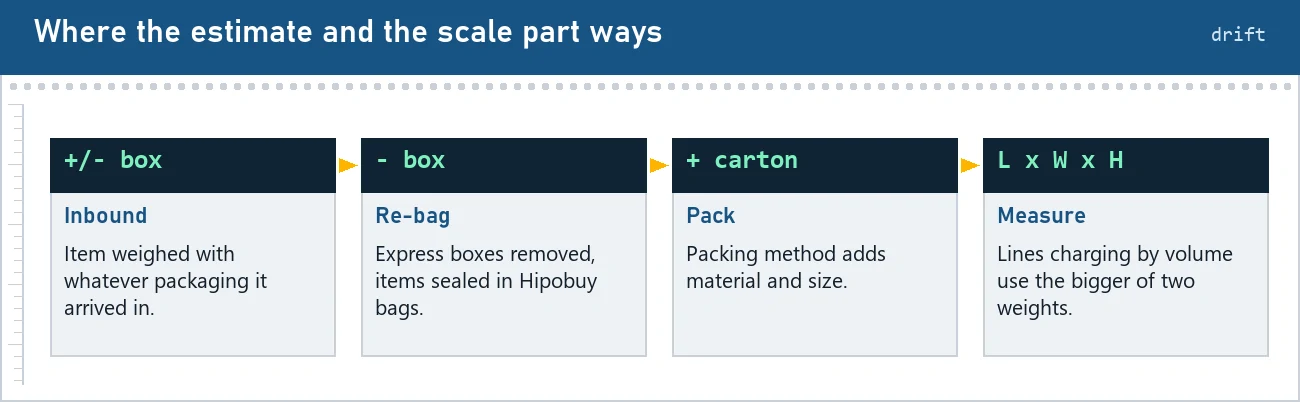
Hipobuy's rules for forwarding and inspection (inspection rules) say that after checking quantity, colour and size the warehouse removes the original express box and seals products in Hipobuy self-sealing bags. Fragile items, items whose express box serves as their packaging and oversized items keep their original boxes, and the page adds that the specific handling depends on actual operation.
For weight this cuts both ways. A seller's outer carton that was weighed on arrival and then thrown away makes the estimate too high. A product box that stays, such as a shoebox, keeps its weight, and the packing then adds a carton around it. The parcel row in Hipobuy's own guide shows a finished parcel at 1,200 g and 45 x 20 x 10 cm, charged by actual weight: a long, flat shape that could just as easily have been billed by volume on another line.

Packing method, the choice a rehearsal locks
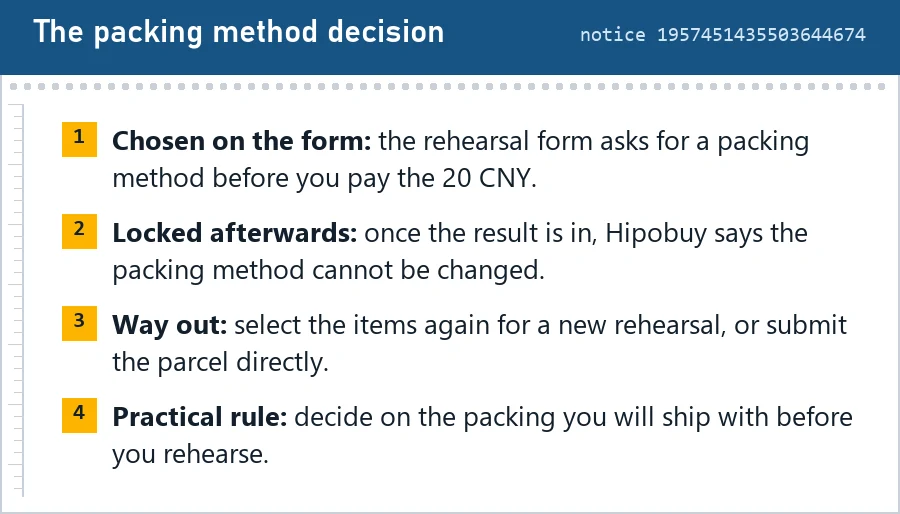
The rehearsal form asks for a packing method before you pay; Hipobuy's screenshots show "Carton packaging". After the result, Hipobuy says the packing method cannot be changed, because the packing method affects the weight.
That has a practical consequence. A rehearsal answers "what does this parcel weigh packed this way", not "what is the lightest way to pack it". If you want to compare two packing choices you need two rehearsals, and each is a separate fee. Decide the packing first, then rehearse once.
Hipobuy does not publish a list of packing methods with their weights, and the screenshots only show one option. If you want to know what the choices are before paying, open the rehearsal form and look at the drop-down: the fee is charged on Confirm, not on opening the page.
Size, when the box sets the charge
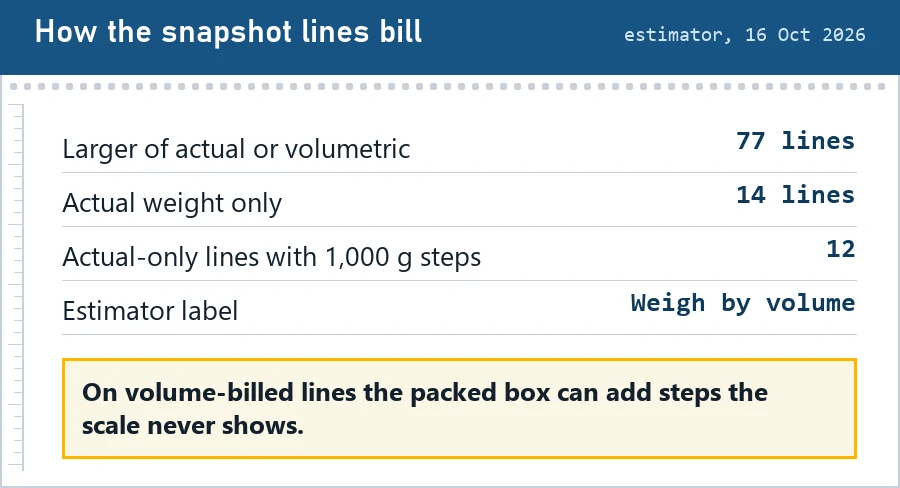
Most snapshot lines charge on whichever is bigger, scale weight or volumetric weight; a minority, mostly postal lines with 1,000 g steps, use the scale alone. The estimator flags each line, either with the label "Weigh by volume" or with a note that the line goes by actual weight.
On a volume-billed line, a carton a few centimetres too long can lift the chargeable weight by more than one step even when the scale barely moves. This is the part of drift the estimate is worst at, because inbound dimensions describe items, not the packed box. A rehearsal returns the packed dimensions, so it catches it. The break-even tool takes this into account only through your doubt figure: if the box is the worry, widen it.
When knowing the weight changes the cheapest line
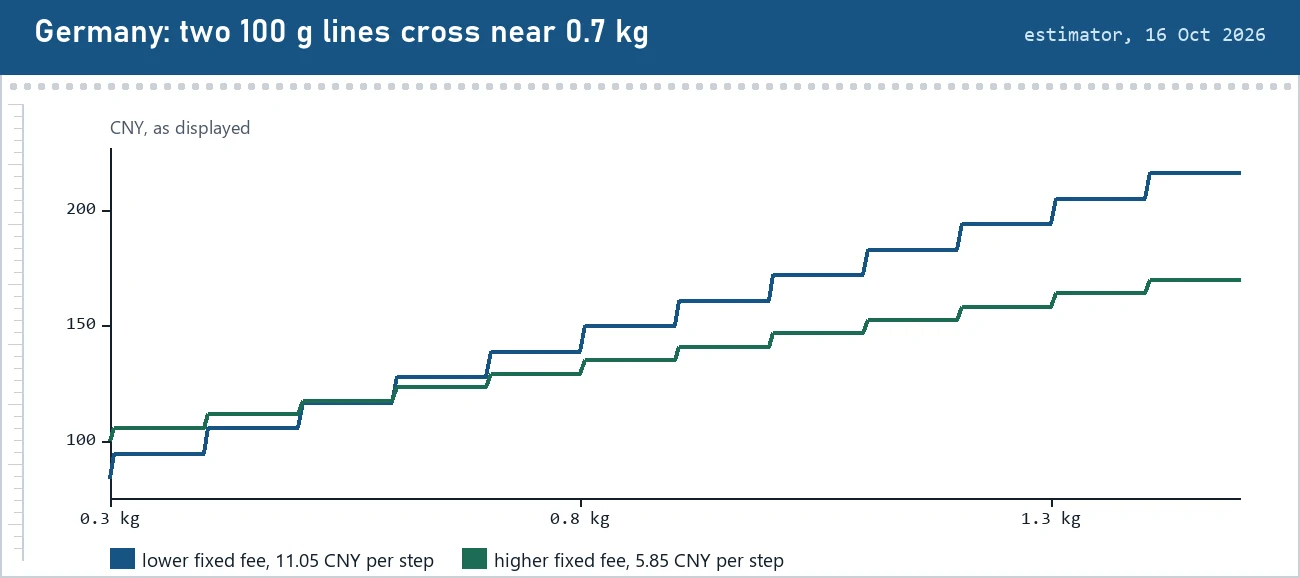
Lines combine fixed per-parcel charges with weight charges, so their price curves cross. In the Germany snapshot, a line with a fixed charge of about 51 CNY and 11.05 CNY steps is cheaper up to roughly 700 g; above that, a line with a fixed charge of 82.50 CNY and 5.85 CNY steps wins. If your estimate sits near a crossing, a few hundred grams of drift can make you choose the wrong line.
That is the second thing a rehearsal can buy, and the break-even tool checks it whenever you pick a destination. In worked case 4 the line choice is worth up to 9.61 CNY, more than the settlement side, though still less than the fee.