Estimated and actual billing weight at Hipobuy, and the one-step refund rule
How Hipobuy prepays shipping on an estimate, settles after packing, and why three of its pages describe the refund differently.
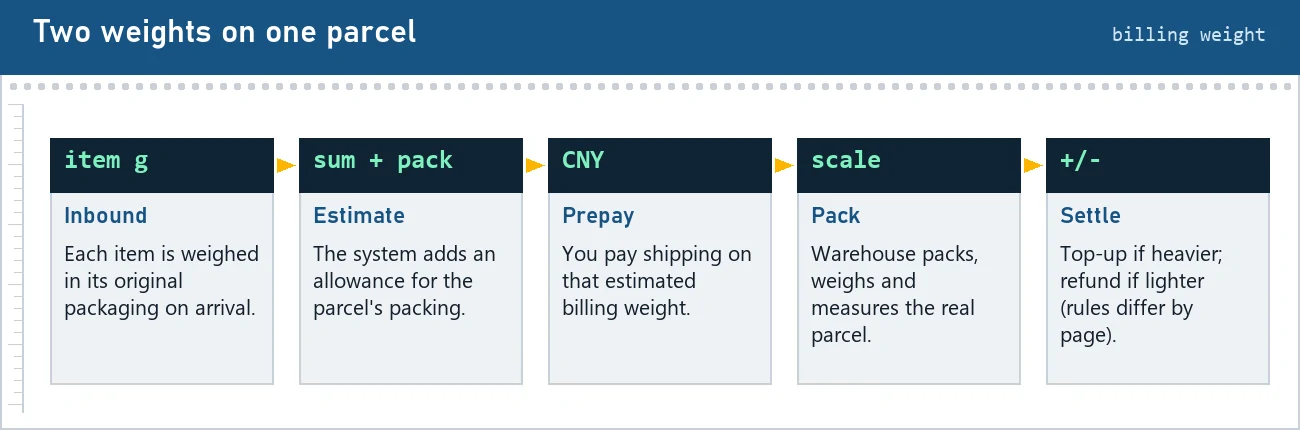
Two weights on every parcel
Hipobuy's FAQ separates an estimated billing weight from an actual billing weight. The estimate starts at inbound weighing, which records each item's weight in its original packaging when it reaches the warehouse. At the moment of submission, the system turns those inbound figures into a forecast of the packed total. That forecast is what the submit page charges you for.
The actual billing weight comes later. After packing, the warehouse weighs the parcel and measures its dimensions, and unless the logistics provider adjusts them, those warehouse figures are the final basis for the charge. Many international lines charge whichever is greater, the scale weight or a volumetric weight worked out from the box (the three dimensions multiplied together, then divided by a figure that differs by line), so dimensions may set the price. Some lines in the snapshot use actual weight only; check your selected line’s rule. Hipobuy's "How to charge the parcel's shipping fee" page says the same in its own words: the warehouse-page fee is a prepaid amount, and the final fee is calculated only after the package is fully packed.
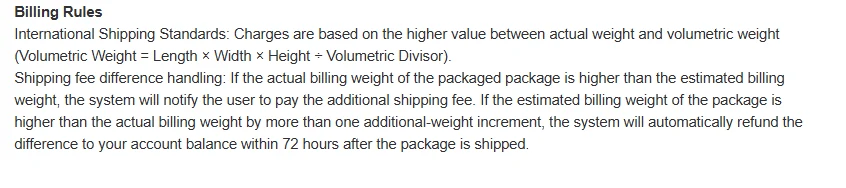
The FAQ wording: a refund only beyond one step
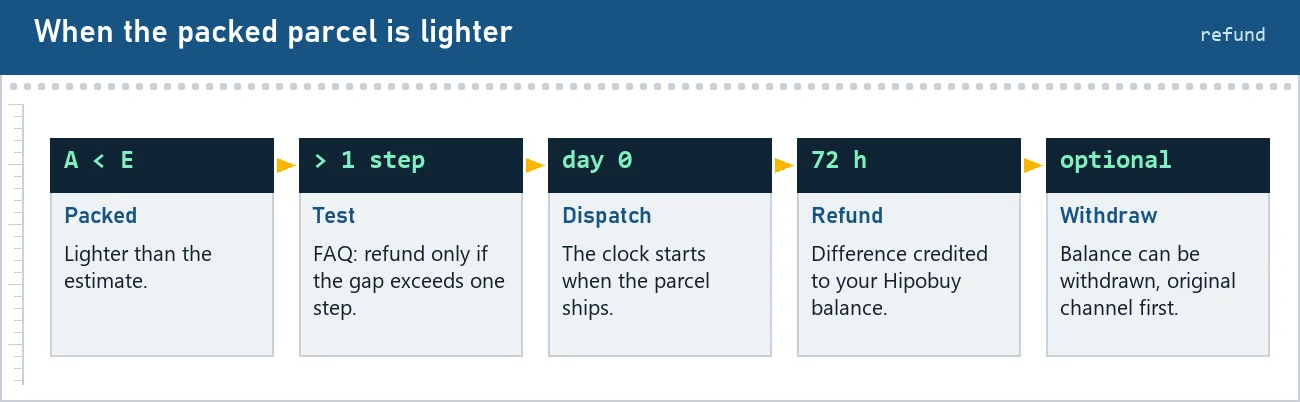
The FAQ on estimated and actual billing weight (notice 1775427065686327297) gives the most detailed rule, cropped below. A heavier packed parcel means the system notifies you to pay the additional shipping fee. For a lighter one the refund is automatic and lands in your account balance within three days of shipment (Hipobuy writes 72 hours), but only if the gap between estimate and actual billing weight is more than one additional-weight increment.
"Additional-weight increment" is the step after the first weight: 100 g on most lines, 500 g or 1,000 g on others. The page does not say whether the refund is the whole difference or the difference less one step; this site reads "refund the difference" literally, as the whole difference, and flags it as a reading.
Two other pages say any overpayment comes back
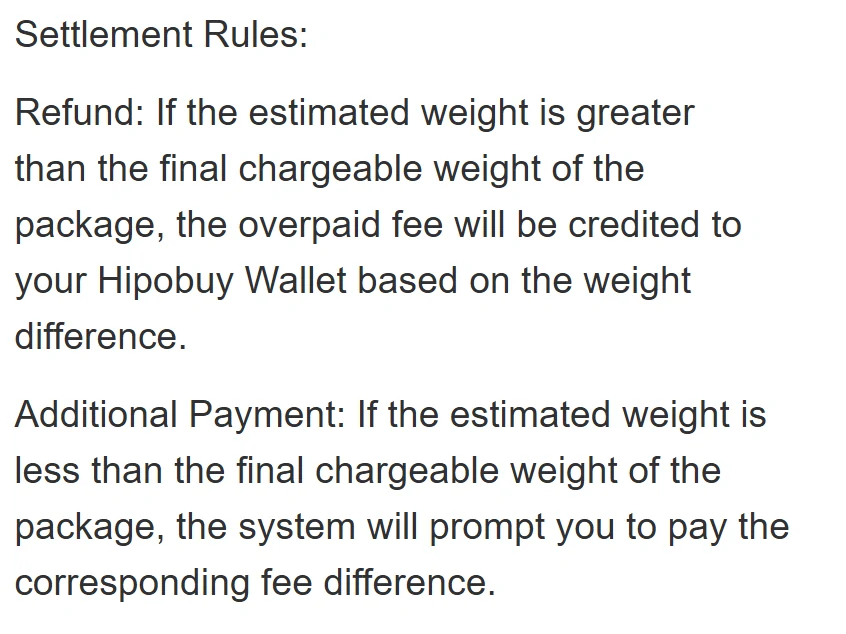
The page "How to charge the parcel's shipping fee" (notice 1934873877851672578) has settlement rules with no threshold at all: if the estimated weight is greater than the final chargeable weight, the overpaid fee is credited to your Hipobuy Wallet based on the weight difference.
The beginner guide (beginner guide) is broader still. Its note says the final cost is set by the carrier from the parcel's final weight and size, and any difference from your deposit is refunded or charged.
Three pages, two rules. Under the FAQ, an estimate that is high by one step or less leaves money with the parcel. Under the other two, it does not. Hipobuy has not said which wording governs, so the break-even tool shows the FAQ reading in its third ticket and states underneath that, if any difference is refunded, a rehearsal can only pay back through line choice and certainty.
How wide the unrefunded band is
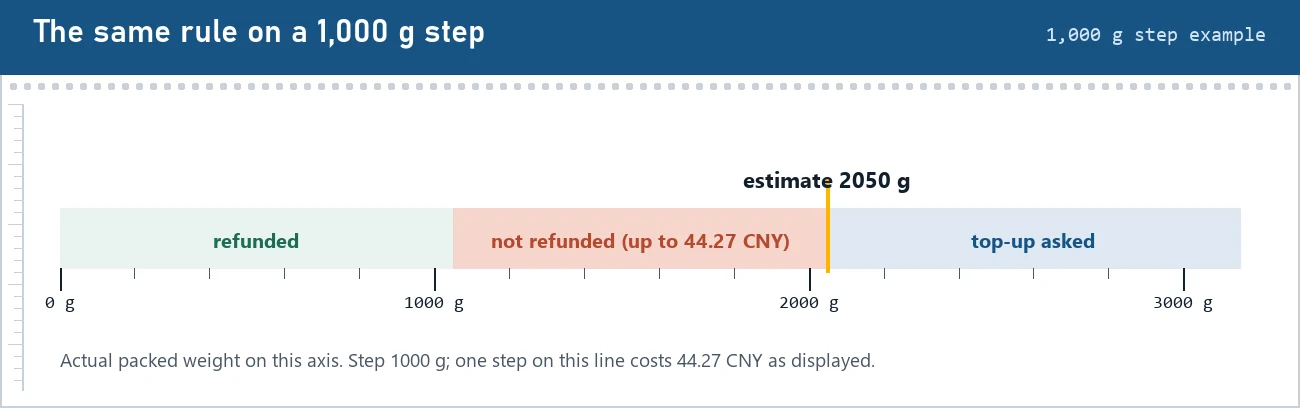
Under the FAQ wording the unrefunded band always runs from the estimate down to one step below it. Its width in grams equals the step; its value in money is at most one step price, because inside a single step the charge changes by one step at most. On the 1,000 g line drawn below, a Canada surface line priced at 44.27 CNY a step in the snapshot, an estimate of 2,050 g leaves anything packed between 1,050 g and 2,050 g unrefunded, and anything packed between 1,050 g and 2,000 g has already dropped a full step.
Narrow steps make a narrow band. That is why a 100 g line rarely justifies a rehearsal on settlement alone, and why 500 g and 1,000 g lines often can. The weight steps page lists the step sizes destination by destination.
Top-ups when the parcel comes out heavier
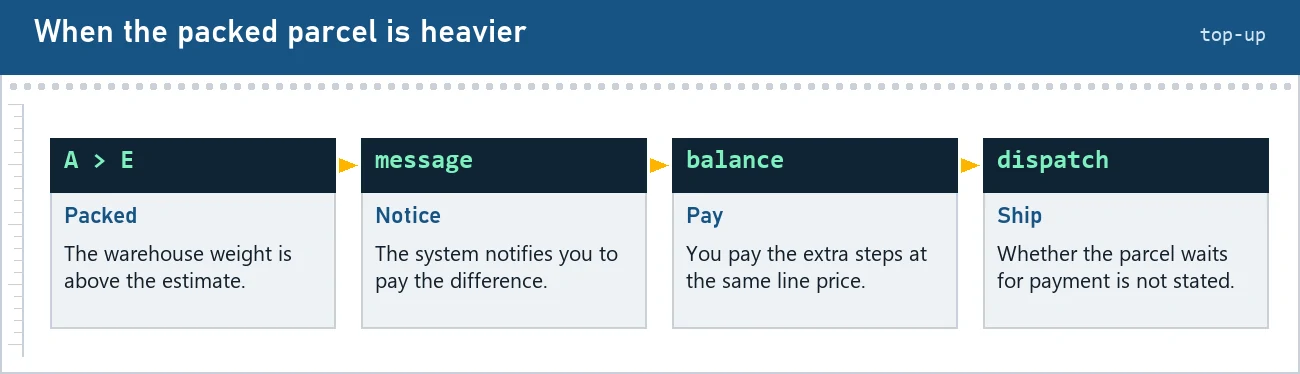
A heavier packed parcel costs exactly what it would have cost had you known the weight: the extra steps at the same line price. Hipobuy's FAQ says the system notifies you to pay the additional fee; the charging page says the system prompts you to pay the corresponding difference. Neither page says whether the parcel waits for that payment or how long you have to make it. Keep some balance available in the days after you submit.
So the top-up side of the range costs you time, not money. A rehearsal removes it, but only by charging 20 CNY up front, which is why the break-even tool counts top-ups as zero loss and puts them in their own ticket.
Where refunds land and how fast
Refunds from settlement go to your Hipobuy balance (the FAQ) or Hipobuy Wallet (the charging page), not to the card or PayPal account you paid with. The FAQ gives 72 hours after shipment as the deadline. From the balance you can spend the money on the next order or ask for a withdrawal; Hipobuy's withdrawal page says it refunds to the original top-up channel first.
If you paid with Hipobuy coins and another method together, Hipobuy's combined-payment rules apply to refunds as well; the coins part goes back to coins. For the break-even decision none of this changes the amount, only where it ends up.